
Expansive Listening
Beyond the words, beyond the individual

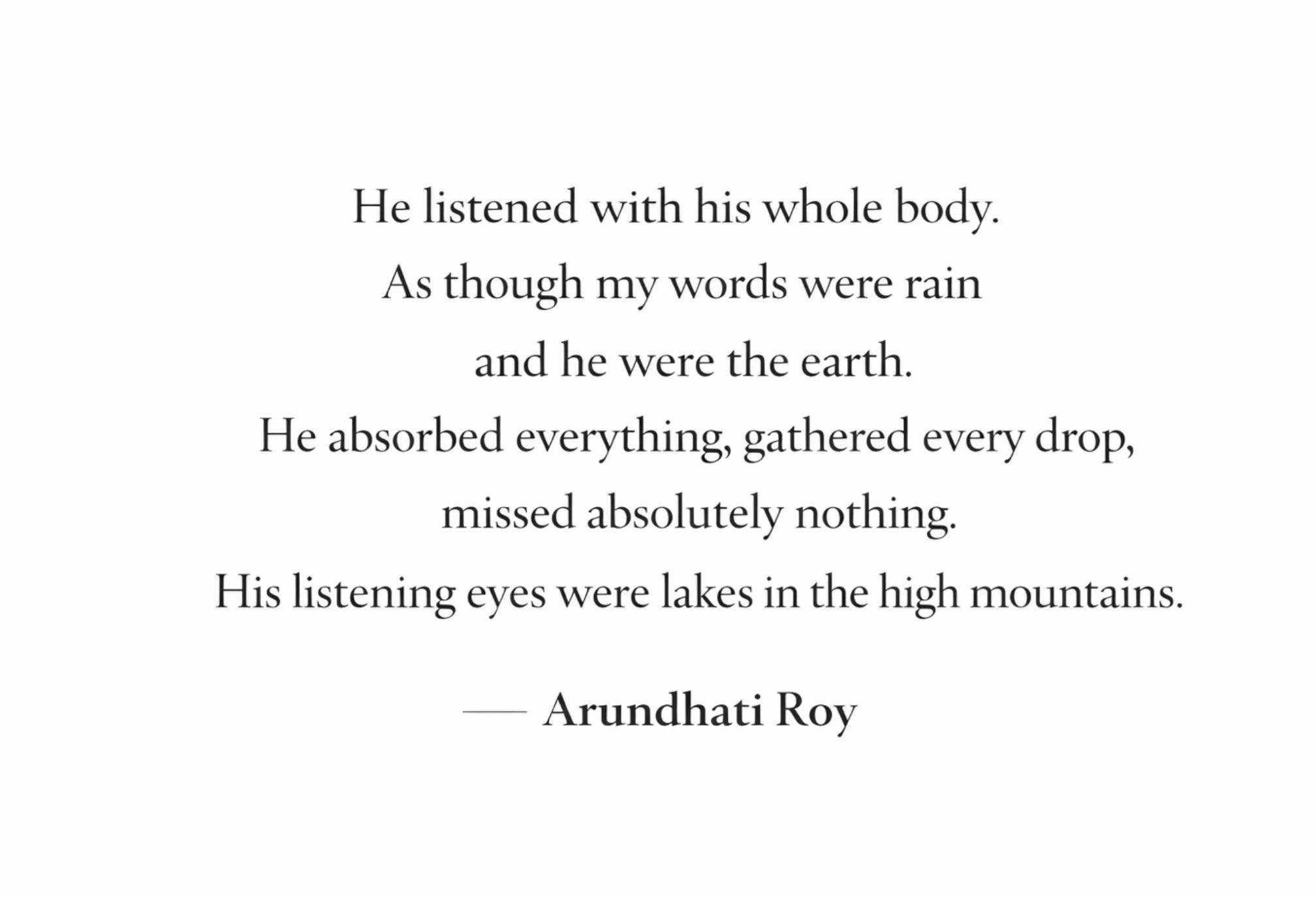
I was struck by Arundhati Roy’s account of being listened to by her friend John Berger. She describes a listening that is deeper, more embodied; a soul listening that takes us into different relational territory.
Arundhati Roy was staying with John Berger in his house in the French Alps, and my hunch is that the setting mattered. Being in the mountains has always impacted on the way I listen, both to nature and to my own body and thoughts. Berger asked Arundhati Roy if she would read from her new novel: The paragraph below captures her experience:
“John Berger could have written a book called ‘The ways of listening’. He listened with his hold body. As though my words were rain and he were the earth. He absorbed everything, gathered every drop, missed absolutely nothing. His listening eyes were lakes in the high mountains. It was love, there was no other word for it. I don’t think that stillness, that quality of attention is even possible in digital age humans who suckle on mobile phones from the day they’re born. It’s a generational thing. Lost forever I believe.”
Arundhati Roy ‘Mother Mary comes to me’ pg 328 .
Her writing raised two questions for me.
Listening in the Digital Age
Firstly, the question about how the space for listening is being eradicated by the digital age. I understand and share her concerns, but also I hope that this isn’t totally the case. There are folks who read to their children, who tell them stories and adults who listen in theatres, or go to mountains and forests and to monasteries to soul-listen in more expansive ways.
Expansive Listening
Secondly, I reflected on professional listening. How we psychoanalysts, psychotherapists, coaches, counsellors and spiritual directors listen. We are trained to be active listeners, (I never quite understood the meaning of this). Lacanian psychoanalysts pay particular attention to wordplay, double meanings, connections, gaps...... Freudians pay attention to verbal slips, (parapraxis);the analyst listens for patterns, continuities, breaks and surprises in our speech. The analyst/therapist is trained to suspend their attention hoping to capture moments when the unconscious speaks. Counsellors and coaches are less focused on the unconscious and more on their ‘presence’ and ‘unconditional regard’ as Carl Rogers puts it. Yet these techniques, whilst useful in helping/analysing the client, are not the same as the expansive listening. Expansive listening goes beyond what we hear, it’s a deep and rich listening to the other’s words, and also to how they are spoken and presented. Expansive listening involves listening to what is being spoken, and to the context- environment from which the words emerge (for words are not owned only by the speaker).
Expansive listening allows us into a different relationship with the other, to listen to them with our bodies and souls, and to let the unconscious speak between us, and give space for nature and the social to speak through us.
When was the last time you were expansively listened to?
When did you last expansively listen to another; including yourself, your body nature and the social?